Feature · 17 November 2026
Three AI labs, three routes to compute, one island
Anthropic, Google and OpenAI get their computing power in different ways. Follow any of the three far enough and it reaches the same factories in Taiwan.

Anthropic, which plans to start trading in New York this week, has had to open its books, and they show a company that runs on rented computing power. Its revenue for January to September 2026 was US$33.2bn, 1,206% more than a year earlier, and its run-rate revenue reached US$81bn at the end of October. To keep up, it has signed purchase commitments and leases worth US$900.9bn, substantially all of it for compute and infrastructure. It spreads the work across four chip families: AWS Trainium, Google TPUs, Nvidia GPUs and AMD GPUs. 1
Google takes the opposite road and makes its own chips. Alphabet said Google Cloud revenue was US$30.7bn in July to September, up 103%, and chief executive Sundar Pichai pointed to demand for its TPU systems "across a wide range of customers". The Gemini app has reached one billion users. Feeding all this cost Alphabet US$51.4bn in capital expenditure in the quarter and US$132.0bn in the first nine months. 2 Its Ironwood TPU, designed with Broadcom, is made by TSMC on its N3P process. 6
OpenAI publishes no accounts, so its route shows up in its suppliers' announcements instead. Nvidia said OpenAI will deploy at least 10 gigawatts of its systems, with Nvidia investing up to US$100bn as each gigawatt goes in, the first in the second half of 2026 on the Vera Rubin platform. 3 AMD signed up for 6 gigawatts of its GPUs, starting with Instinct MI450 chips in the same half-year. 4 And OpenAI is designing its own accelerators with Broadcom, 10 gigawatts of them, with racks due from the second half of 2026 to the end of 2029. 5
Subscribers get each new feature by email on Friday, before it is on the site. Every listed Taiwan company reports its November sales by 10 Dec. The free Friday email on 11 Dec has the summary: which supply-chain groups grew and which shrank.
Free: the field guide to Taiwan's AI supply chain (PDF) at once, then the email every Friday. Unsubscribe in one click.
Three strategies, then: use everyone’s chips, build your own, or do both. But the roads meet. Anthropic warns its investors that "the majority of the world's most advanced chip manufacturing capacity is concentrated in Taiwan, primarily at Taiwan Semiconductor Manufacturing Company". 1 Tom's Hardware notes that TSMC fabricates chips for all five hyperscalers and for Broadcom, the company behind both Google's TPUs and OpenAI's own chip. 6
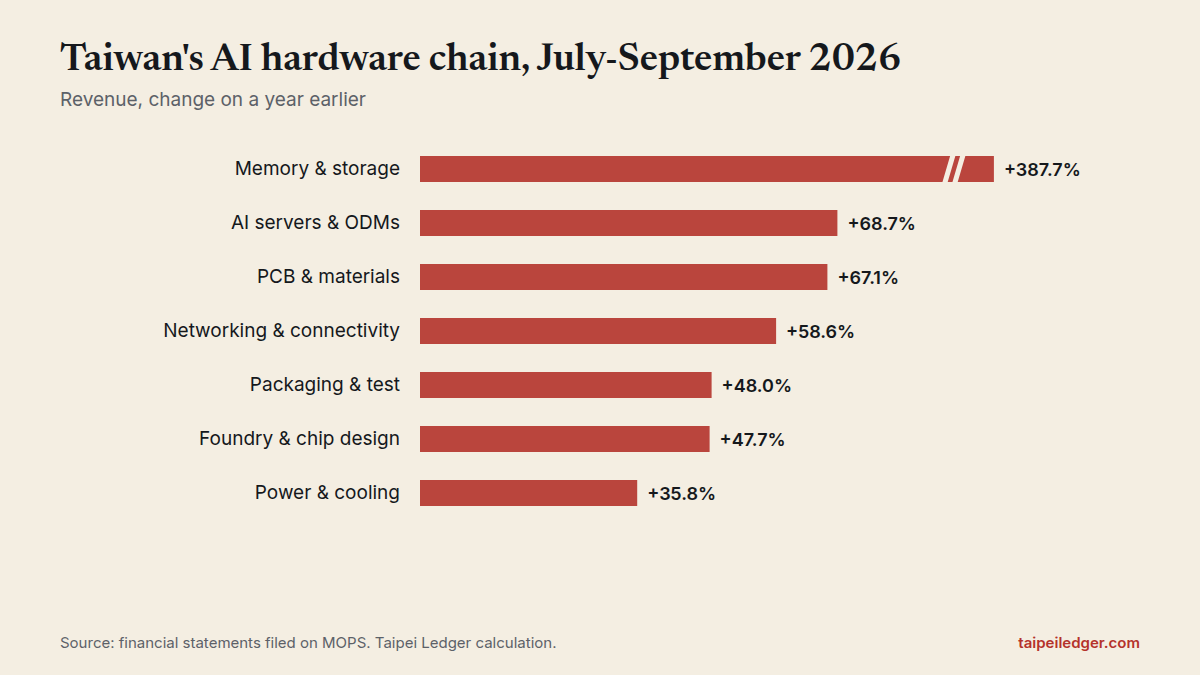
Taiwan's third-quarter results show what that means at the other end. TSMC's revenue was NT$1.49tn in July to September, +50.9% on a year earlier. Alchip Technologies and Global Unichip, the design houses that help customers turn their own chip designs into TSMC orders, reported revenue changes of +296.5% and +117.7%. The eight AI server makers and assemblers tracked by Taipei Ledger, from Hon Hai to Quanta Computer and Wiwynn, booked NT$6.17tn, +68.7% on a year earlier.
The next marks on the calendar are close. Anthropic's shares are due to start trading on Thursday, and the first gigawatts from Nvidia, AMD and Broadcom are scheduled for the half-year now ending. Taiwan's November monthly revenue, due in early December, will show whether the server makers' orders kept pace.
Sources: 1. Anthropic, PBC: Amendment No. 2 to Form S-1 (SEC, 10 Nov 2026) · 2. Alphabet Announces Third Quarter 2026 Results (8-K exhibit 99.1, 28 Oct 2026) · 3. OpenAI and NVIDIA announce strategic partnership to deploy 10 gigawatts of NVIDIA systems (NVIDIA, 2 · 4. AMD and OpenAI announce strategic partnership to deploy 6 gigawatts of AMD GPUs (AMD, 6 Oct 2025) · 5. OpenAI and Broadcom announce strategic collaboration to deploy 10 gigawatts of OpenAI-designed AI ac · 6. The custom AI ASIC state of play (Tom's Hardware, May 2026)