Feature · 25 November 2026
America's new chip rule: what it asks of Taiwan
A US rule in force since 19 November 2026 reaches Taiwan's foundries, its chip designers and the factories its companies are building in Southeast Asia.
On 19 November 2026 the US Commerce Department put a new rule on advanced chips into force, the same day it appeared in the Federal Register. 1 It is an interim final rule: it applies first and takes comments afterwards. Much of it is aimed at China. A good part of it lands on companies in Taiwan.
The first part closes a gap. Companies headquartered in China already needed a licence to obtain the most advanced American-designed AI chips, but they could rent the computing power in data centres abroad. Now a licence is needed to send those chips to any data centre that gives such companies access to more than 12,000,000 'aggregate TPP', the rule's measure of computing power. Data centres already doing so must get a licence within 90 days, which by our count is 17 February 2027. Systems that suggest products or posts on shopping sites and social media are left out. 1
The second part is closest to Taiwan's foundries and packagers. A contract chipmaker or an assembly and test house must check who designed an advanced logic chip before making it. The rule removes ways for designers based in China, or owned from there, to clear that check, and does the same for designers in several other countries. 1 TSMC said it would comply, according to DIGITIMES, which reported that the rule reaches beyond AI processors. 2
Subscribers get each new feature by email on Friday, before it is on the site. Every listed Taiwan company reports its November sales by 10 Dec. The free Friday email on 11 Dec has the summary: which supply-chain groups grew and which shrank.
Free: the field guide to Taiwan's AI supply chain (PDF) at once, then the email every Friday. Unsubscribe in one click.
Taiwan's own chip designers sit on the other side of that line. The rule text lets designers headquartered in Taiwan, and not owned from China or Macau, count as 'authorized' if they share information with the foundry, until December 31, 2026. After that date a designer must have applied to become an 'approved' designer, and the authorized status lapses 180 days after the application. 1 The five Taiwan-listed designers on our AI page, among them MediaTek and Alchip, reported combined October revenue of NT$77.0bn, a change of +30.6% on a year earlier.
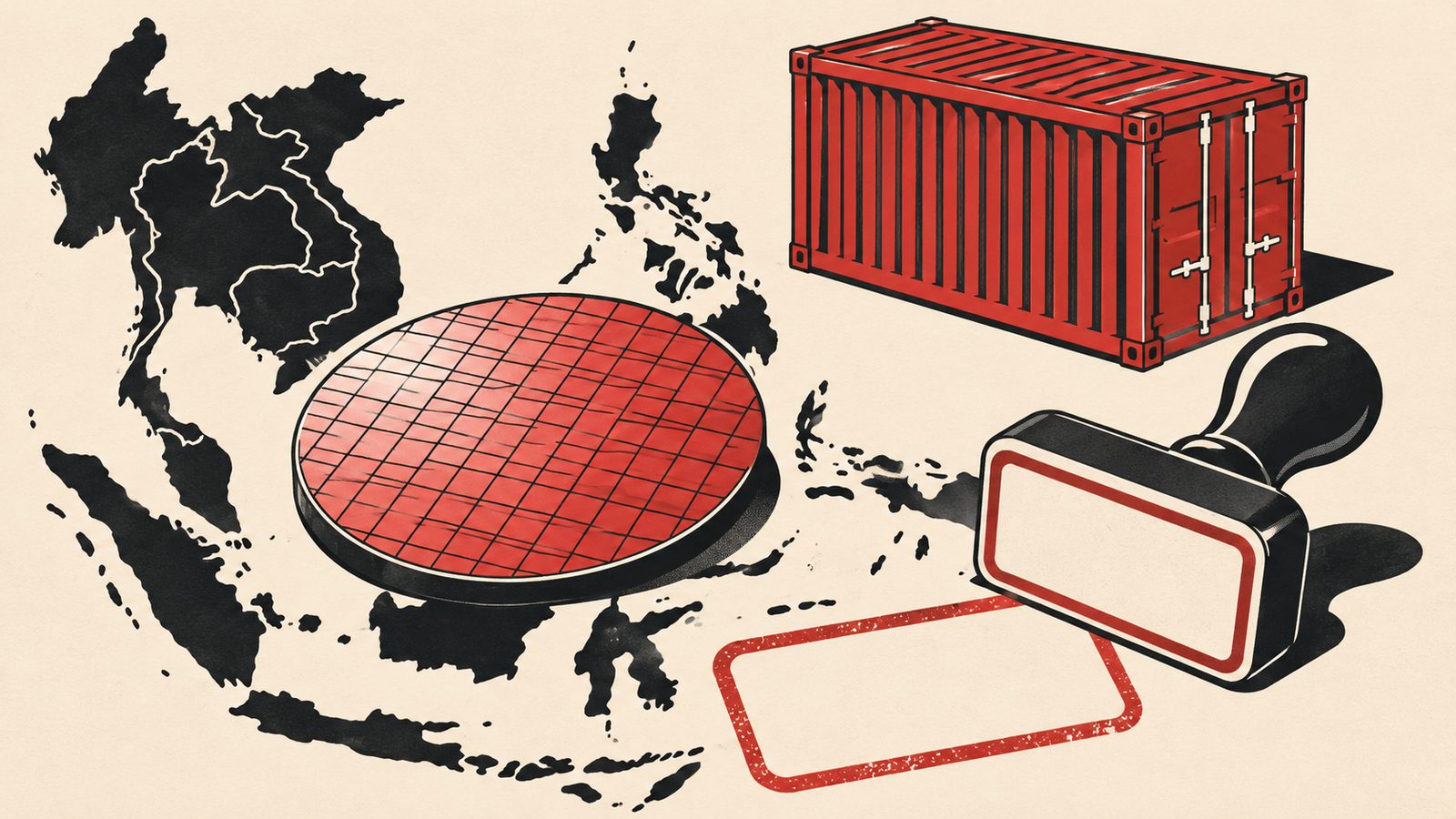
The third part names five countries. Exports of advanced chips to Indonesia, Malaysia, Singapore, Thailand and Brazil now need a licence, unless the buyer is a company headquartered in the United States that meets reporting rules. Washington says these countries carry a higher-than-normal risk of chips being sent on. 1
Taiwan's server and packaging companies have been adding capacity in exactly those places. Wiwynn, which builds servers for cloud companies, approved a US$200 million capital increase in its Malaysian unit on 6 November. 3 Inventec has put about 8.6 billion baht into its Thai subsidiary this year. 4 ASE added US$120 million to its Malaysian assembly and test unit in April. 5 The filings do not say what the plants make or for whom, so how much of their work falls under the exemption for American buyers is not yet clear.
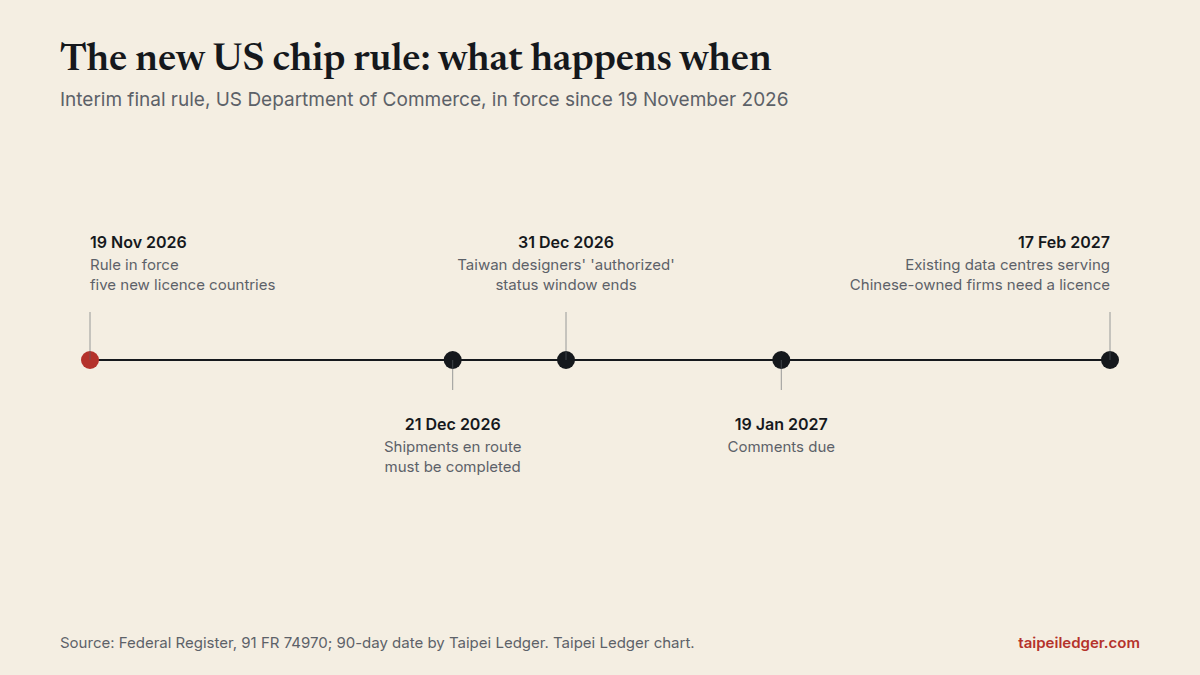
The rule also sets a clock (chart). Shipments already on their way on 19 November 2026 can go ahead if they are completed by December 21, 2026. Comments are due by January 19, 2027, and the text may still change after that. The rule also formally scraps the Biden-era AI Diffusion Rule, which was never enforced. 1 For Taiwan's suppliers, the practical work starts now: checking who their customers' customers are.
Sources: 1. US Department of Commerce, BIS: Addressing Remote Access to Advanced Semiconductors, interim final r · 2. DIGITIMES: TSMC says it will comply with new US rule that strips Chinese chip designers of a key exe · 3. Wiwynn (6669): board resolution on a capital increase in Wiwynn Technology Service Malaysia (MOPS, 6 · 4. Inventec (2356): capital increases in Inventec Electronics (Thailand) (MOPS, 10 Mar and 28 Jul 2026) · 5. ASE Technology (3711): capital increase in ASE Electronics (M) Sdn. Bhd., Malaysia (MOPS, 15 Apr 202